Contacts Info
-
Office 2704, Silver Tower, Marasi Drive st, Business Bay, Dubai, UAE
P.O Box 453599 - info@ecopaper.ae
- +971 54 5555 471
[ECO Friendly]
Materials - So what is our ECO PAPER made from?
Our main material, calcium carbonate, is one of the most abundant natural substances on Earth.
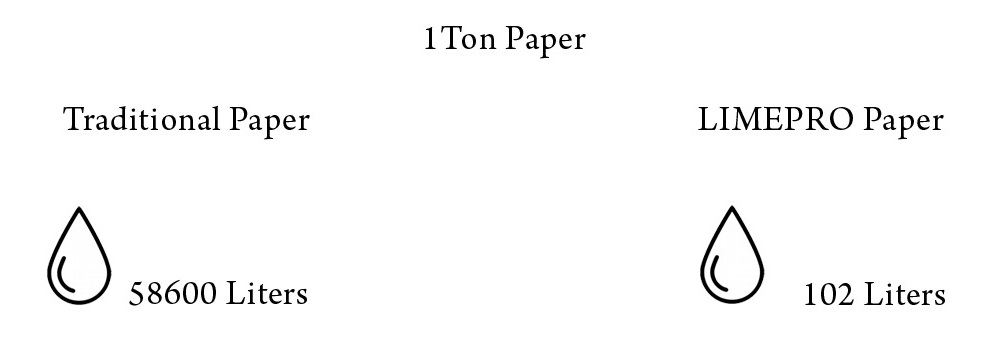
When native forests are cleared, many are replaced with tree farms. While fast-growing trees absorb carbon, they reduce biodiversity, disrupt ecosystems, and can even reshape entire nations, as seen in Uruguay. Research from the Australian National University shows untouched forests store three times more carbon than tree farms — proving it’s better to leave them alone.
When native forests are cleared, many are replaced with tree farms. While fast-growing trees absorb carbon, they reduce biodiversity, disrupt ecosystems, and can even reshape entire nations, as seen in Uruguay. Research from the Australian National University shows untouched forests store three times more carbon than tree farms — proving it’s better to leave them alone.
Water consumption
ECO PAPER saves water — protecting our planet’s most precious resource.
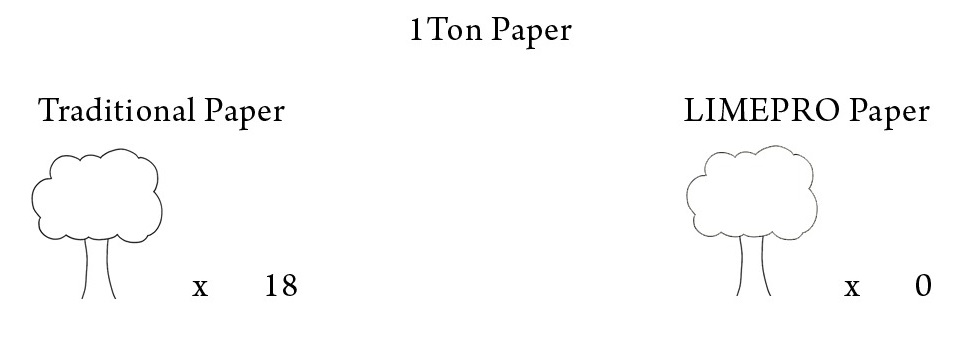
ECO PAPER uses significantly less water to produce than regular paper. Each metric ton of ECO PAPER requires 102 liters of water, which is circulated in a closed system and reused.
Those 102 liters of water would produce only 9 A4 sheets of traditional paper. Making one ton of virgin paper requires about 58,600 liters of water, while recycled paper still needs around 21,900 liters — and it ultimately depends on virgin fibers.
Waste production & recyclability
Traditional paper can never use 100% of a tree. Producing one ton creates over 150 kg of solid waste — and even more (about 190 kg) when using recycled materials due to impurities. Plus, paper fibers weaken after repeated processing, so traditional paper can only be recycled 5 to 7 times.
In making ECO PAPER, scraps from trimming and test batches are fully recycled into new production. With no solid waste and infinite recyclability, ECO PAPER outperforms traditional paper.
Unlike plant-based cellulose that weakens with repeated processing, calcium carbonate stays intact — allowing ECO PAPER to be recycled endlessly.
Energy use and carbon emissions
We take carbon emissions seriously — so seriously that we are carbon neutral.
Producing traditional paper from timber requires nearly six times more energy than making ECO PAPER.
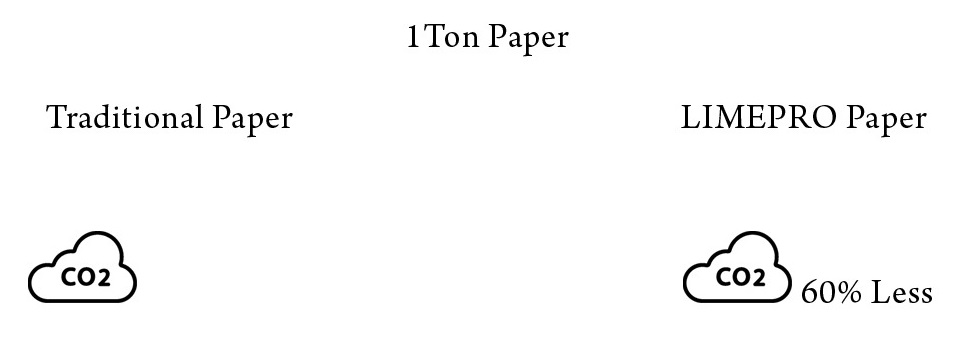
We power ECO PAPER production with solar energy, resulting in a carbon footprint 60% smaller than regular paper.
Reducing our carbon footprint isn’t enough — we work to neutralize it. By investing in carbon offsets, we ensure our actions never come at the planet’s expense.
So how does ECO PAPER feel to use?
ECO PAPER contains no plant fibers, so it has no grain direction. This gives a smoother, more fluid writing experience and makes the material much stronger. Unlike traditional paper that tears easily along its grain, ECO PAPER stretches before it tears.
Another unique feature of ECO PAPER is its waterproof quality. Unlike traditional paper, it resists moisture — ensuring your notes and ideas stay safe from spills or sudden weather. While absorbent paper has its uses, it no longer needs to be the standard.